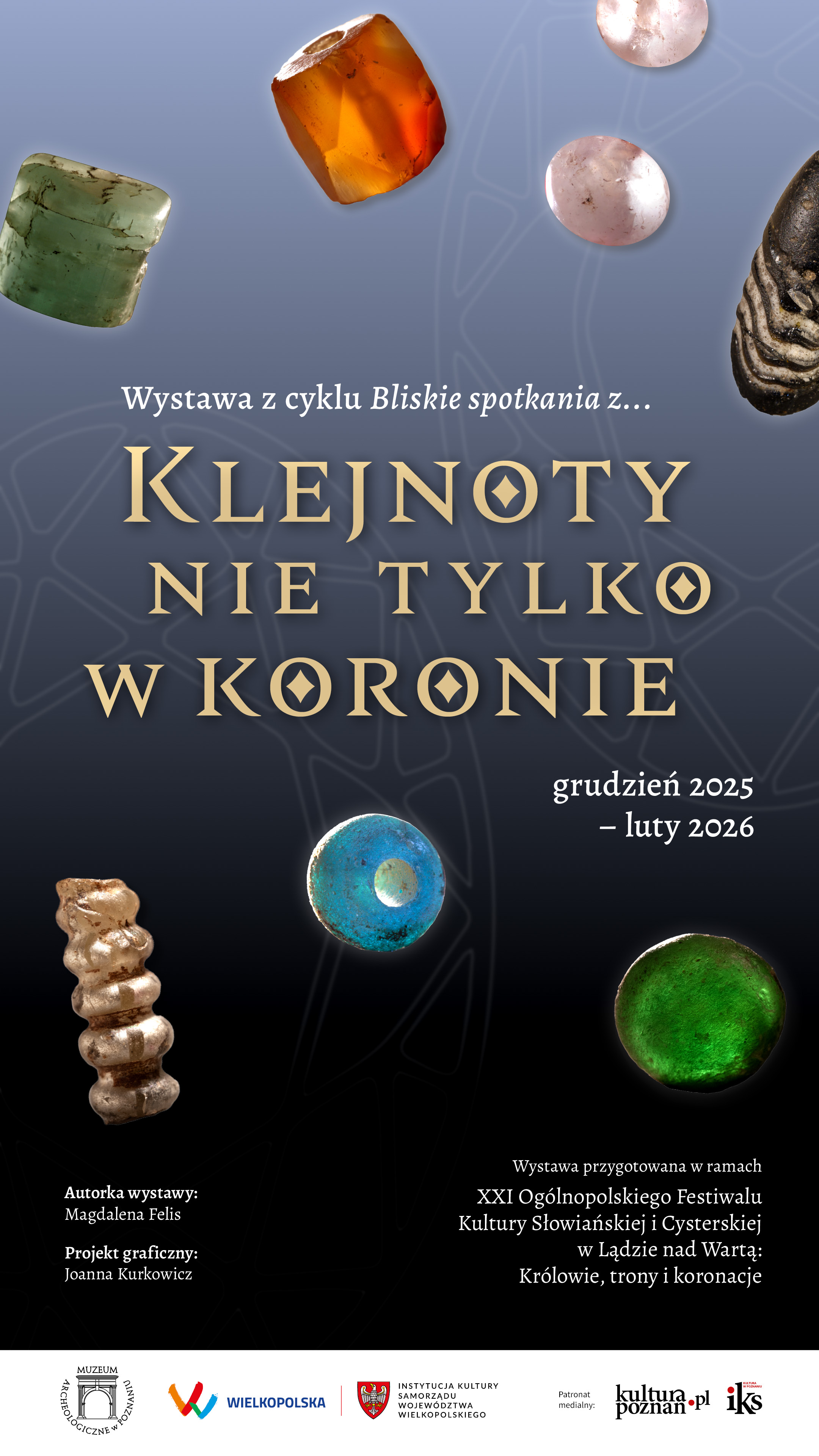
On display: 18.12. 2025 - 28.02.2026
Location: Archaeological Museum in Poznań, 27 Wodna Street
Temporary Exhibition Room on the 1st floor
Curators: Magdalena Felis, Joanna Kurkowicz (graphic design)
Admission with a purchased ticket to the Museum
Precious stones, and above all the jewellery incorporating them, have long served as symbols of status. In the past, minerals were also believed to have healing and magical properties. For this reason, people sought to keep them close not only for their beauty but also for their protective and medicinal qualities. Precious stones additionally carried symbolic meanings, which enhanced their value.
For example, sapphires, due to their colour, were often associated with the heavens; red stones such as rubies and garnets with life force and blood; and purple amethysts with spirituality. Transparent diamonds and rock crystal symbolised purity, while green emeralds were believed to cure illness. Medieval crowns were particularly rich in precious stones, often set in large numbers and usually cut as cabochons, characterised by smooth, unfaceted surfaces.
The crown of Bolesław I the Brave has not survived to the present day, and its precise appearance remains unknown. The crown traditionally referred to as the coronation crown of Polish rulers was in fact created only in the fourteenth century and was first used at the coronation of Władysław I Łokietek in 1320. However, some medieval crowns belonging to European rulers have been preserved, including the Crown of Saint Stephen, the Crown of the Holy Roman Empire, and the Crown of Otto III. These objects shed light on medieval goldsmiths’ art and the precious stones that were particularly valued at the time.
Treasures from distant periods are not found only in crowns. Richly furnished burials discovered in early medieval cemeteries (mainly dating from the 11th and 12th centuries) often contain gold, silver, and bronze ornaments. Among these grave goods, small beads stand out as modest yet remarkable jewels, and it is to them that this exhibition is dedicated.
Beads most commonly occur in the graves of women and children, typically in groups of several. Of particular interest are wealthy burials containing necklaces made up of hundreds of beads; in some cases, their number exceeds one thousand. Individual beads are also occasionally found in male graves.
Common materials used for bead-making included glass, carnelian, rock crystal and amber. Examples made from fluorite, realgar, amethyst and various types of chalcedony (such as agate) have also been discovered, as well as beads made of faience, clay and cowrie shells.
The exhibition presents artefacts from various early medieval sites, including Poznań, Gniezno, Ląd on the Warta River, Bruszczewo, Głuchowo, Krąplewo, Ujście, Giecz, Milicz and Krzanowic. These artefacts are displayed together with contemporary glass beads produced using techniques known in the Middle Ages.
The objects on display come from the collections of the Archaeological Museum in Poznań; the Museum of the First Piasts at Lednica, Giecz Archaeological Reserve branch; the Archaeological Museum, a branch of the Wrocław City Museum; and the Regional Museum in Świebodzin.